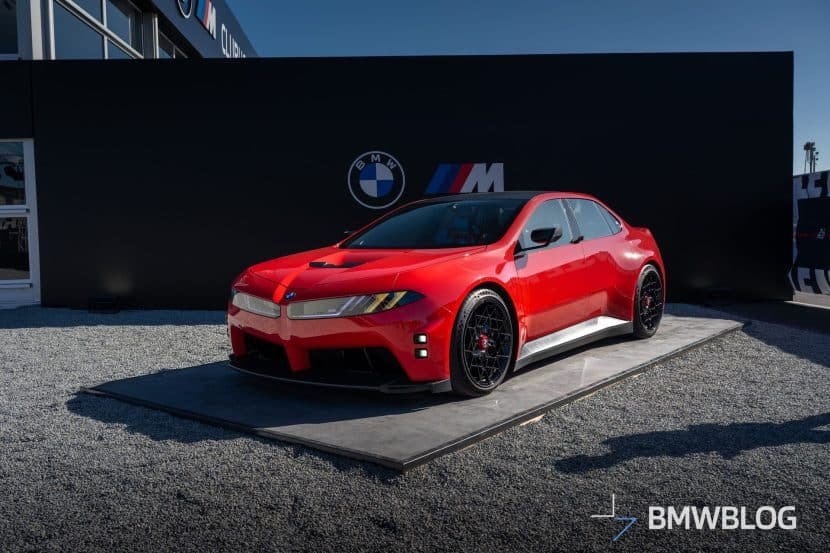
BMW chose Le Mans — the oldest and most storied endurance race in the world — to pull the sheet off the BMW M Concept Neue Klasse, and we were there for it. The car that rolled out under the French sun was not subtle. In Monza Red metallic with flared arches, yellow headlights, and a ducktail spoiler that means business, it is the clearest statement BMW M has made about where the brand is going since the F80 M3 landed in 2014 and put a turbocharged engine under the hood that nobody wanted to like — and then everyone did.
Below are our exclusive photos from the world premiere. But first, let us tell you what you are actually looking at.
A New Design Language For The M Brand

The BMW M Concept Neue Klasse is a design and technology preview of the ZA0, the internal code for the all-electric BMW M3 that BMW has confirmed for a 2027 market introduction. It is built on the same architecture as the upcoming i3 Neue Klasse sedan — which itself arrives in 2026 — but pushed considerably further in every direction. Wider body with flared arches front and rear. Completely redesigned exterior elements. A powertrain that bears no resemblance to what BMW M has produced before.
BMW calls it a concept. The framing — “elements of the concept, including design, materials, driving experience and brand interpretation, will be incorporated into future BMW M vehicles” — is not exactly a disclaimer. This is the electric M3, dressed up in concept clothing.
The timing of the reveal was pointed. On the same weekend, Dries Vanthoor put the No. 15 BMW M Hybrid V8 on BMW M Motorsport’s first-ever Le Mans pole. BMW M had a good few days.
Proportions Typical To An EV

Start with the proportions. The concept is wider than the standard i3 at both axles thanks to the flared wheel arches, and the shoulder line is muscular in a way that the regular car is not. The front end is the most dramatic change. A shark nose profile flows into a kidney grille and headlight assembly that merge into a single unit, something BMW has been moving toward across the range. The new M Yellow Lights are the signature detail: bright yellow light icons that BMW says will become a recurring feature on future M cars, referencing GT racing cars and the M Hybrid V8 endurance racer.

The front apron borrows a trimaran-style bumper form — three-part, inspired by high-speed sailing hulls — that also houses three-dimensional Track Lights in the outer sections. The same Track Lights appear at the rear, flanking a floating diffuser. A proper ducktail spoiler sits at the top of the tail, increasing downforce at the rear axle without resorting to a wing.
The V-shaped hood vent is functional: it supports cooling of the electric drivetrain. The front splitter, the hood vent, and the diffuser all use natural fibre materials, which BMW is also using in the bucket seats inside. For the roof graphic, natural fiber appears for the first time in a refined finish with M branding.
The paint is Monza Red metallic, new for this car. The center-lock wheels are coded in red and blue, the BMW M colors.
The Interior: Driver-First, Screens Second

Inside, BMW M has made a decision that will matter in production: the driver does not disappear into an iPad. The floating dashboard is trimmed in black knit material, and the instrument cluster sits directly in front of the driver where it belongs. There is a central screen, yes, but the architecture is oriented around the person at the wheel rather than built to impress someone filming an interior walkaround on YouTube.
Four bucket seats — rear passengers get individual body-hugging chairs, too, as in the M5 CS (F90) — are trimmed in Bathurst Blue and Berry Red Merino leather. Red five-point harnesses reinforce the motorsport reference. High-quality black knit fabric appears throughout the cabin, a material choice BMW is positioning as premium without relying on conventional leather everywhere.
The overall impression is tighter and more focused than the regular Neue Klasse i3 interior we have seen in concept form, which is exactly what it should be.
Production Summer 2027

The production ZA0 electric M3 arrives in 2027. A parallel G84 M3 — the combustion successor to the current G80 — is also in development for buyers who are not ready to go electric. BMW M is covering both sides of the argument for now.
What the concept does not settle is how the ZA0 will actually feel. BMW M can publish torque figures and describe wheel-specific control algorithms, but the question that will define whether this car matters is simpler: does it reward the driver the way the E46 M3 did, in a way that has nothing to do with acceleration numbers and everything to do with what comes through the wheel mid-corner? A parking lot reveal at Le Mans does not answer that. Neither does a press release that says “particularly direct response characteristics.”
We will be driving it in 2027. Stay tuned.


First published by https://www.bmwblog.com