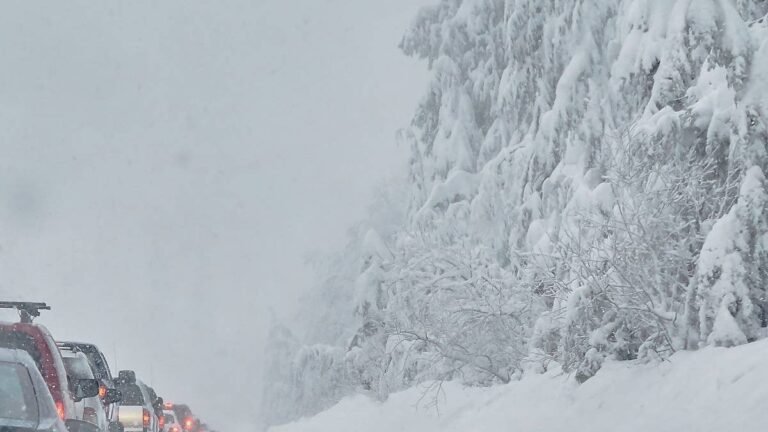
A powerful Pacific storm system is slamming the Sierra Nevada right now, and conditions on California’s mountain highways are about to get significantly worse. The National Weather Service has Winter Storm Warnings active from Lassen County south through Yosemite, Kings Canyon and Sequoia National Parks, with watches also covering Mono County and the greater Lake Tahoe region. The warnings run from 2 AM Tuesday through 5 PM Wednesday, and this is not a system to try to outrun.
The Storm
A mid-level closed low off the California-Oregon coast is pushing inland tonight and will grind through the Sierra over the next 36 hours. The Weather Prediction Center is forecasting snow rates of 1 to 2 inches per hour across the higher terrain, with the heaviest accumulation expected Tuesday night into Wednesday morning.
Snow levels start at 6,000 to 7,000 feet tonight, then drop steadily. By Wednesday they will be sitting at 4,500 to 5,500 feet, which pulls accumulating snow down to elevations that many drivers associate with rain, not winter conditions. At the highest terrain, 1 to 2 feet of snow is forecast. The southern Sierra above 7,000 feet could see 12 to 18 inches, with a few inches possible as low as 4,500 feet.
Wind is the force multiplier. Sierra crest gusts could reach 75 to 90 mph, with 40 to 50 mph at lower elevations. That combination of heavy snow and high wind will produce extended whiteout conditions on exposed passes and ridgelines. The NWS is warning that visibility could drop below a quarter mile at times.
The Highways
I-80 over Donner Pass, US-50 over Echo Summit and US-395 along the eastern Sierra are all in the direct path. Chain controls are virtually guaranteed, and full closures are on the table once snow rates peak overnight Tuesday into Wednesday. This is the third Sierra storm in two weeks to threaten these corridors. I-80 closed in both directions during the April 12-13 storm after multiple spinouts on Donner Summit. Drivers should expect the same scenario this week.
As of early Tuesday afternoon, more than 24,000 Californians were already without power, and the storm has not yet reached peak intensity.
What Makes This One Unusual
This is a late April system bringing mid-winter conditions. The snow level drop from 7,000 feet to 4,500 feet over 24 hours means communities that rarely see accumulation in spring will be dealing with snow on the ground by Wednesday morning. Forecasters also warn that embedded thunderstorms are possible as the cold core of the low moves overhead, and AccuWeather senior meteorologist Dave Houk said a brief tornado cannot be ruled out in the Sacramento Valley on Tuesday.
The storm arrives at a critical moment for California’s water supply. The state’s April 1 snowpack measurement came in at just 18 percent of average, the second-lowest on record. When surveyors checked Phillips Station in El Dorado County, they found no measurable snow at all. Late-season April storms have since helped considerably. Palisades Tahoe has received close to 6 feet of snow this month alone and could approach 7 feet by month’s end. This system may be one of the last meaningful opportunities to boost the snowpack before summer.
What To Carry
Caltrans will require chains on most vehicles above 4,000 to 5,000 feet, and AWD with snow tires may still need chains under R-2 and R-3 controls. Carry tire chains and know how to put them on, plus a blanket, flashlight, portable phone charger, water, food and a full tank of fuel. If you get stranded, stay with your vehicle, run the engine in 15-minute intervals and crack a window for ventilation.
Late-season Sierra storms catch many drivers off guard because winter gear has already been stowed for the season. For a full breakdown on handling snow and ice at speed, review Autoblog’s guide to best practices for winter driving. If your vehicle is not ready for a sudden return to winter, our winter car readiness checklist covers tread depth, emergency kits and everything in between.
Check Caltrans QuickMap for current highway conditions, chain controls and closures before attempting any Sierra crossing.