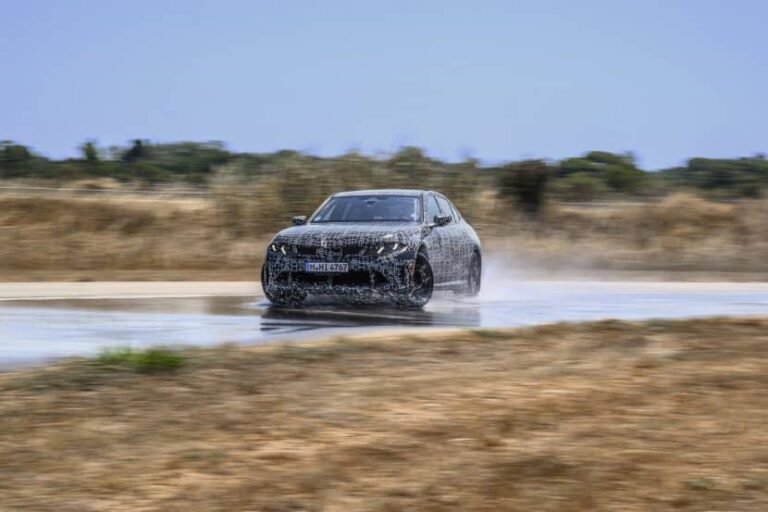
The new BMW M350 xDrive makes more torque than an F80 M3 ever did, Competition Package included. Not just the base car’s 406 lb-ft. The Competition Package’s torque figure too, unchanged from the standard car, the trim level BMW added specifically at the time to make the M3 feel like the closest thing to a race car it would sell with a warranty. An M Performance model, sitting one rung below the real thing, now beats it on the number that actually predicts how a car pulls out of a corner.
This isn’t really a story about one spec sheet. It’s a story about how the entire bottom half of BMW’s performance lineup quietly stopped being a consolation prize.
The Old Deal Was Simple
For most of my life following this brand, the arrangement was easy to explain to anyone. You bought the six-cylinder car if you wanted most of the fun without the M tax, the M service intervals, or the M insurance quote. The 335i, the 135i, later the M340i and M240i, these were the cars for people who loved driving but didn’t need to lap a track on a Tuesday, quick but not M cars, and everybody understood the difference. The gap between them was wide enough that nobody seriously debated which one was actually faster. That gap is slowly closing with every new generation 3 Series, and it’s exciting if you’re a die hard BMW fan.
The New M350 Will Be Exciting

The M350 xDrive making 437 hp in the US and 443 PS in Germany, the same output described two different ways, isn’t really the interesting part on its own. What’s interesting is what it beats. A standard F80 M3 made 425 hp. The M350 clears that by 12. The F80 M3 Competition Package, which needed an entire trim level and a price bump to get to 444 hp, only leads by 7, a margin small on paper, yet tangible while driving, thanks to the various software and hardware upgrades.
Torque isn’t close at all. The M350’s 428 lb-ft beats both F80 variants by 22 lb-ft, because the S55 never gained a pound-foot when BMW bolted on the Competition Package a decade ago. A 48V mild hybrid motor did what a bigger turbo couldn’t, filling in the bottom of the curve in a way the old M engine simply wasn’t built to do.
| F80 M3 (2014-2018) | F80 M3 Competition (2016-2018) | 2027 M350 xDrive | |
|---|---|---|---|
| Engine | 3.0L twin-turbo inline-6 (S55) | 3.0L twin-turbo inline-6 (S55) | 3.0L turbo inline-6 (B58) + 48V mild hybrid |
| Power | 425 hp / 431 PS | 444 hp / 450 PS | 437 hp / 443 PS |
| Torque | 406 lb-ft / 550 Nm | 406 lb-ft / 550 Nm | 428 lb-ft / 580 Nm |
| Drive | Rear-wheel drive | Rear-wheel drive | All-wheel drive (xDrive) |
| Transmission | 6-speed manual or 7-speed DCT | 6-speed manual or 7-speed DCT | 8-speed automatic only |
| 0-60 mph | 4.1 sec (tested) | 4.0-4.1 sec | 4.1 sec (claimed) |
| Top speed | 155 mph | 155 mph (174 mph optional) | 155 mph |
| Curb weight | Approx. 1,560-1,622 kg | Approx. 1,560-1,661 kg | Approx. 1,800 kg (estimated) |
None of this happened because BMW decided to make its M Performance cars into secret M cars. It happened because turbocharging plus mild hybridization became cheap and effective enough that big torque numbers stopped being something you had to earn with a special engine program. The B58 in the M350 is closely related to the one doing duty in an X3 M50. The extra shove comes from an electric motor doing a job BMW used to solve with displacement and boost pressure. This is just what modern powertrains do now, whether or not the car wearing them has a full M badge.
The M340i Already Told Us This Was Coming

This isn’t the first time the gap closed unexpectedly. The M340i, on paper, made 382 hp, which put it within shouting distance of an E46 M3’s 333 hp from a full engine generation earlier, and closer still to an early S55 F80 in a straight line than anyone at BMW M would probably like to admit. The M240i did something similar to the E46’s little brother, the M3’s stablemate. Each time, the story got waved off as an anomaly, a one-generation blip that would correct itself once the next M car arrived with more power. And each time, it did correct, but only because the M division kept escalating: bigger turbos, wider tires, S58 replacing S55, until the current M3 sits comfortably clear at over 500 hp in Competition trim.
That escalation is the actual story here, more than any single spec sheet. M Performance cars aren’t creeping up on M cars by accident. M cars are having to keep running just to stay ahead of a segment beneath them that gets faster every time BMW refreshes an engine. And I have no doubt that the next generation G84 BMW M3 will jump a bit in power as well.
Why This Is Good News With A Catch

For anyone actually buying one of these cars, this is close to unambiguously good. You can now get most of an M3’s straight-line performance, better everyday comfort, all-wheel drive for actually awful weather, and a lower price, without any of the ownership realities that come with a car built primarily to be fast on a track. The M350 will not scare you on a wet road the way a lightly driven RWD M3 will. It will not demand you learn what a differential lock does before you trust it in the rain. For the overwhelming majority of buyers who will never see a track day, that trade is obviously correct.
The catch is what it does to the cars above it. If an M Performance model can match or beat a decade-old M3 on paper, the actual M car has to justify its existence some other way, and lately that other way has mostly been more power, more weight, more complexity, and a higher price. The G80 M3 is a properly enormous car compared to the E46 it’s supposedly descended from, and a meaningful part of why is that BMW can’t let the M badge mean merely “quick” anymore, because the M Performance cars already have that covered. M has to mean something more extreme, which pushes the flagship further from the kind of car most of its own history was built on: light, direct, and only as powerful as it needed to be.
Where I Land On This
I don’t think BMW is doing anything wrong here, and I don’t think M Performance cars getting this good is a problem to be solved. But I do think the M badge is being pushed into a corner it didn’t ask for, defending territory that used to belong to it by default and now has to be defended with bigger numbers every single generation. The M350 xDrive beating an F80 M3 on torque isn’t a fluke or a marketing trick. It’s what happens when the car underneath keeps getting better every generation and the car on top has nowhere left to go but up. I’d buy the M350 if I needed one car to do everything well. I’d still want the real M car if I ever wanted one thing done as well as it’s possible to do it. What I don’t think exists anymore is a clean, obvious reason to pick the M car purely because it’s faster. That used to be the whole point.
First published by https://www.bmwblog.com