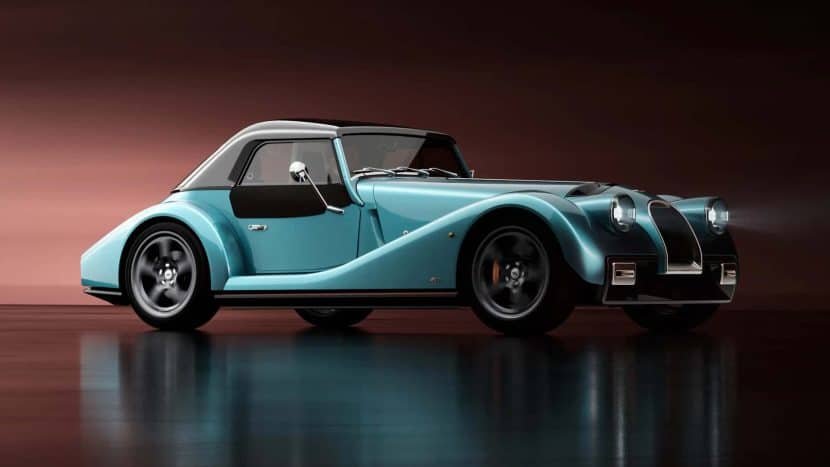
BMW’s B58 engine is one of the great all-rounders in the modern automotive world. It powers the M340i, the Z4 M40i, the 540i, the X5 xDrive40i, the Toyota GR Supra, and even the Ineos Grenadier. It has been tuned, chipped, and modified by enthusiasts to well beyond 600 horsepower. But one of its most interesting recent deployments isn’t in a BMW at all — it’s in a hand-built British roadster that weighs little more than a modern compact hatchback.
Amazing Power-to-Weight Ratio
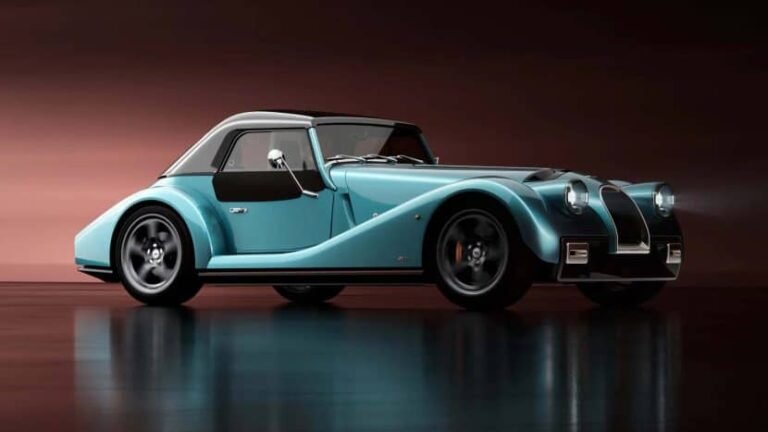
Meet the Morgan Supersport 400: the most powerful production car Morgan has ever built, and the latest milestone in a BMW-Morgan partnership that stretches back more than 25 years. For 2026, Morgan has taken the B58 inline-six — the same basic architecture found across BMW’s performance line-up — and extracted 408 PS (300 kW / 402 hp) and 500 Nm of torque from it. That power goes through a ZF eight-speed automatic gearbox to the rear wheels, in a car that weighs just 1,170 kg.
At 2.93 kg per PS, the Supersport 400 would rank among the very best power-to-weight ratios of any road car — a figure that puts it ahead of plenty of six-figure supercars.
What the B58 Does in a Car This Light

To put the Supersport 400’s weight in context: a BMW M340i — one of the B58’s most natural homes — weighs around 1,650 kg. The M5 (G90) tips the scales at over 2,300 kg. Drop essentially the same engine into a 1,170 kg aluminum-chassis roadster, and the performance arithmetic changes completely. Morgan claims 0–100 km/h in 3.6 seconds and a top speed of 290 km/h. Those are numbers that comfortably match much more expensive, purpose-built sports cars.


But the more interesting point isn’t the straight-line speed. It’s what that power-to-weight ratio does on a winding road, in a car with no electronic cocoon, no adaptive cruise control managing your inputs, and a roofline just 1.29 metres off the ground. At 290 km/h, you will feel every one of those km/h in a way that you simply won’t in a sealed, insulated sports saloon. That’s the Morgan proposition, and the Supersport 400 makes it more compelling than ever.
More Than Just an Engine Swap

The Supersport 400 isn’t simply a standard Supersport with the B58 turned up. Every car comes fitted with the Dynamic Handling Pack as standard — something that is optional on the regular model. That means fully adjustable Nitron dampers at both axles and revised suspension geometry, engineered to give more predictable, accurate responses to driver inputs. An optional limited-slip differential is also on the options list for those who want maximum traction on corner exit.
Unique to the 400 is a bespoke high-flow exhaust system developed specifically for this model. Morgan says it delivers a more pronounced, purposeful six-cylinder soundtrack — which, given how good the B58 sounds in standard BMW applications, should be something worth hearing. Lightweight 19-inch forged wheels are standard, new front wing vents improve airflow, and the lower body trim gets a gloss finish in place of the standard car’s satin grey.

Inside, leather and Alcantara can be combined with unique seat and door stitching patterns. Bespoke dials distinguish the 400’s instrument cluster, and — notably for anyone who has sat in a standard Supersport — an optional aluminum gearshift knob is available to replace the stock BMW unit, which has always looked slightly out of place in Morgan’s handcrafted cabin.
25 Years of BMW Power in a Morgan
The Supersport 400 marks a significant moment in what is now a 25-year collaboration between Morgan and BMW. Over those two-and-a-half decades, BMW engines have become integral to Morgan’s performance identity — from early straight-sixes through to today’s B58 family. Morgan describes the Supersport 400 as the start of a new era, with a string of bespoke and limited-edition models planned over the next 18 months. If this is the baseline, that’s an exciting pipeline.
Production starts in May, with orders open now. The car is available in Germany and across Europe. For BMW fans curious about just how far the B58 can go in a completely different context, the answer — at 408 PS in a 1,170 kg roadster hitting 100 in 3.6 seconds — is: very, very far.
That figure is, of course, before options. Morgan’s configurator offers a wide range of personalisation choices — colours, bronze-finish or painted wheels, red brake callipers, interior trim combinations — all of which tend to nudge the final number upward. For those seriously weighing up those options, it’s not a bad problem to have.
[Photos: Morgan Motor]


First published by https://www.bmwblog.com