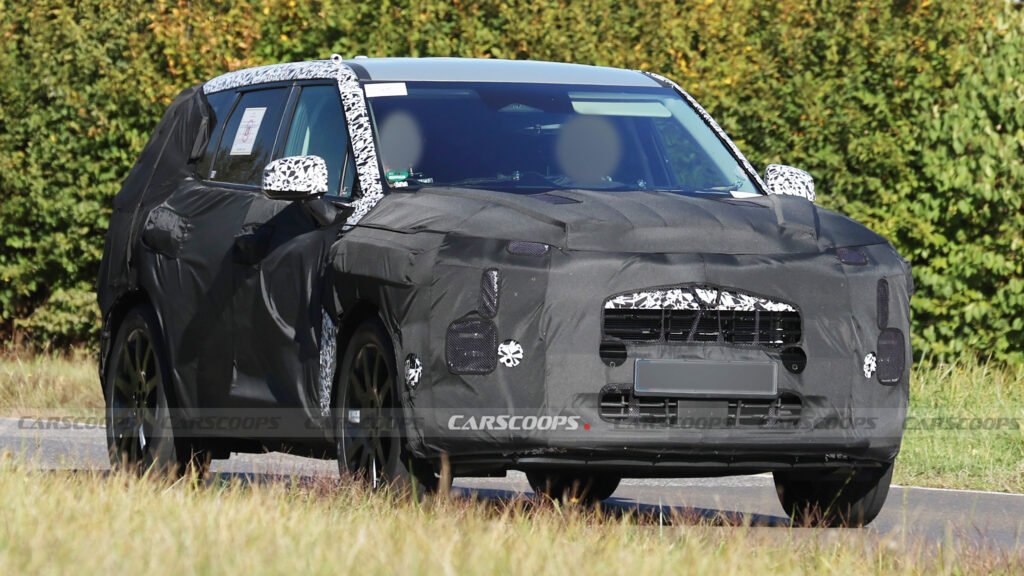
- The new Kia Sportage will be slightly larger than the outgoing model.
- Like the new Tucson, Kia will prioritize new hybrid and plug-in hybrid versions.
- Kia is expected to reveal the new Sportage next year as a 2028 model.
Hyundai revealed its all-new Tucson last week, introducing a radical new design, an all-new interior, and doubling down on hybridization. Now it’s Kia’s turn, which has just started testing the next-generation Sportage. Like the outgoing model, this new one will share many of its components with the 2027 Tucson.
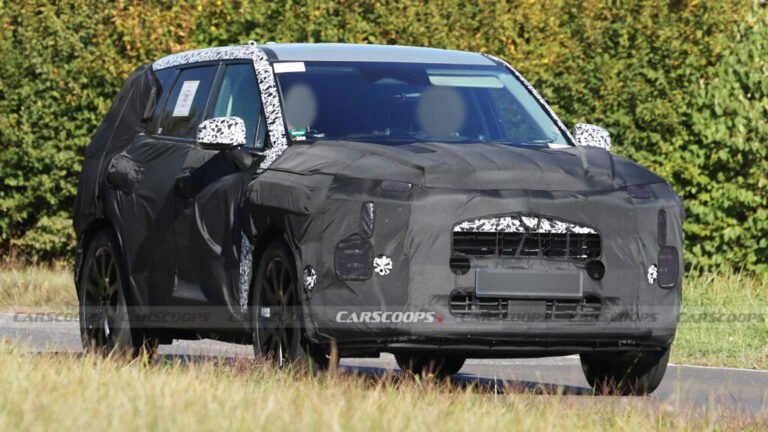
This prototype is covered in camouflage and thick black body cladding, hiding much of its design from view. However, we can see that it will have a boxier design than the outgoing Sportage, more akin to the new Tucson. This is especially apparent with the shape of the side windows, free from any curves and instead using sharp angles.
Read: 2027 Hyundai Tucson Lands With Wild Design And New Hybrids
Peeking out from beneath the cladding is a redesigned front-end housing a different grille. Then there’s the matter of the lights. Unlike the current Sportage, where the headlamps and DRLs are housed within a large single unit, the next-gen Sportage is expected to adopt a split headlight design. It’s too early to determine the shape of these lights, but it appears there may be both vertical and horizontal LEDs, with the main headlamps positioned within square housings further down on the bumper.
Baldauf
You’ll notice this prototype is also rocking a set of sporty black wheels, but they’re only being used for testing, and won’t be available on the production car. The overall shape of the new Sportage will also bring it in line with Kia’s electric SUVs, including the EV5 and EV9, both of which have similar upright designs, flat roofs, and an emphasis on sharp angles, rather than soft creases and curves.
The rear-end design remains a mystery because of the cladding Kia’s engineers have fitted. It’s safe to assume that, like most other current Kia models, the taillights will be bold, perhaps making the Sportage look more like a concept car than a production model.
A Familiar Platform And Engines
Baldauf
Like the outgoing Sportage, as well as the all-new Tucson, the Sportage will use Hyundai and Kia’s familiar N3/N4 platform. Like the Tucson, it will be about two inches (60 mm) longer than the current model and have a slightly longer wheelbase.
Powertrains should be shared between the Tucson and Sportage. As such, both turbocharged 1.6-liter inline-four and naturally aspirated 2.0-liter inline-four options are expected, with power ranging between 148 horsepower and 190 horsepower. In the Tucson, torque sits between 141 pound-feet and 195 pound-feet (191 Nm – 264 Nm), depending on specification, so we expect to see similar figures with the Tucson.
Both hybrid and plug-in hybrid models will also be available. Like the Tucson, both should use Hyundai’s familiar turbo 1.6-liter four-cylinder. The traditional Hybrid pairs this engine with a 1.49-kWh battery and a small electric motor, resulting in 233 hp or 242 hp, depending on the market. The Tucson PHEV adds a larger 17.1-kWh battery and boasts 288 hp and 258 lb-ft (350 Nm), figures that will likely carry over to the Sportage PHEV.
Baldauf