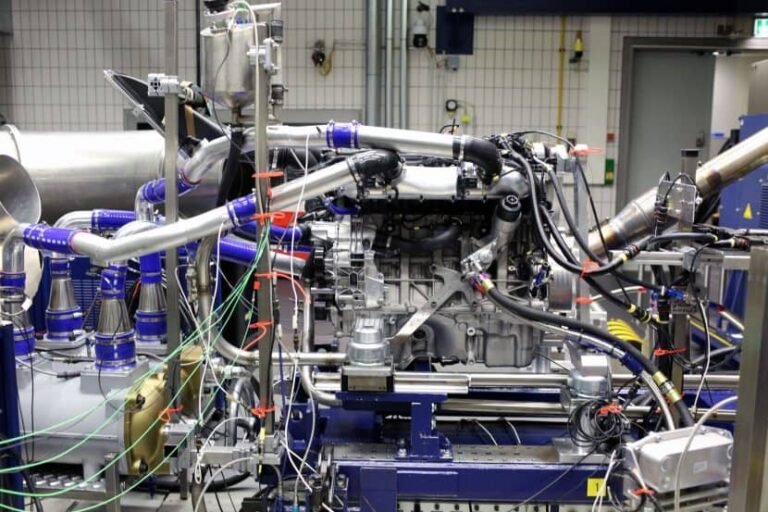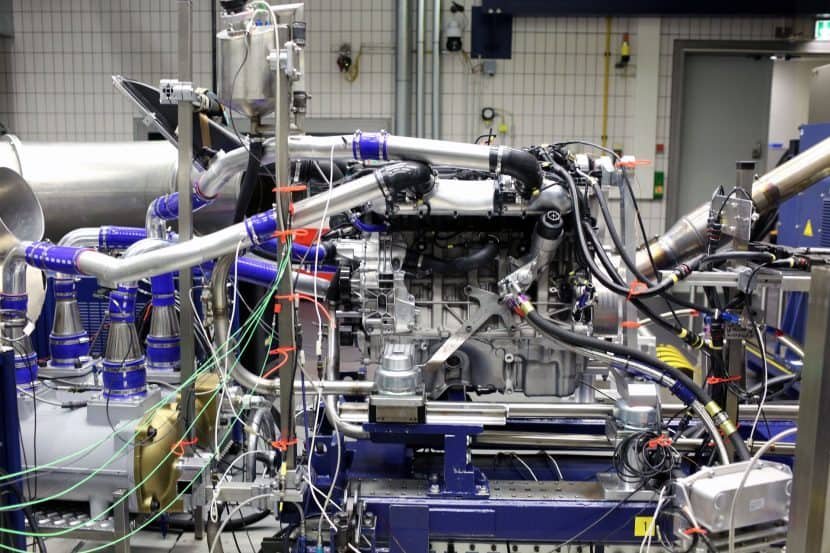
Look up “P58” in a BMW parts catalog and you will find a genuine, brand-new racing engine for sale, no team affiliation required, just a serious budget. The P58 is BMW Motorsport’s name for the 3.0-liter twin-turbo straight-six that powers the BMW M4 GT3, and it is about as close as a customer can get to buying a factory race engine off a shelf.
BMW rates the P58 at up to 590 horsepower and 516 lb-ft (700 Nm) of torque, though the number that actually shows up on a given race weekend depends on what the Balance of Performance rules in that series allow. It first raced in June 2021, debuting in the M4 GT3 at the Nürburgring Endurance Series, and it is still the engine in the updated M4 GT3 EVO that BMW rolled out for the 2025 season.
Built From The S58, Not From Scratch

The P58 is not a clean-sheet design. It starts life as the S58, the same 3.0-liter inline-six in the G80 M3, G82 M4 Competition, and the X3 M and X4 M. Both engines share the basics: an aluminum block and head, twin mono-scroll turbochargers, direct injection, and connecting rods and pistons that carry over from the road engine essentially unmodified. BMW Motorsport did not reinvent the bottom end. It reused what already worked on the street and rebuilt everything around it for racing.
What Actually Changes Between Street And Track

The two engines diverge fast once you get past the shared architecture. The road-going S58 has to idle in traffic, survive 100,000-plus miles on whatever pump fuel a customer feeds it, and meet emissions rules in a dozen markets. The P58 has one job: stay alive through flat-out racing stints, including 24-hour stints, without cooking itself. That meant:
- A dry-sump oiling system with engine-mounted oil tanks and an integrated oil-to-water exchanger, replacing the road car’s wet sump, so oil does not surge away from the pickup in long, high-G corners
- Two throttle valves and a motorsport-specific charge-air cooling setup, where the S58 makes do with one
- A revised engine mounting angle, GT3-spec mounts, and rear torsional vibration dampers tuned for the race chassis rather than the road car
- An exhaust system with a split charge cycle and cooling circuits sized for endurance racing rather than daily driving
BMW has never put a number on that mounting-angle change. The S58 in the road car leans to one side at roughly the same kind of angle BMW’s inline-sixes have used for decades, commonly in the 20 to 30 degree range depending on generation, and BMW’s GT3 materials simply say the P58’s angle is different without saying by how much or what it becomes. What is clear is that the change is not cosmetic: a dry-sump engine sitting at a different angle needs its own oil pan and scavenge layout built around where the oil actually pools under sustained cornering, rather than reusing the road car’s wet-sump pan geometry.
The same logic extends to the intake and exhaust. Once the block sits at a different angle relative to the chassis, the factory manifolds’ flange angles no longer line up the way they did on the road car, which is presumably why the P58 runs its own purpose-built manifolds on both sides rather than carried-over S58 plumbing.
BMW says the P58 is roughly 80 lbs lighter than the 4.4-liter V8 it replaced in the outgoing M6 GT3, which helped BMW rebalance the GT3 car around the M4’s front-engine, rear-drive layout.
Why It Is P58 And Not “S58 Race”
BMW Motorsport has a habit of swapping the S for a P once a production M engine gets built into something that races. The S63 V8 from the M5 became the P63 for the M6 GT3, and later the related P63/1 for the M8 GTE. The S65 V8 from the E92 M3 became the P65 for GT racing between 2009 and 2016. The S58 becoming the P58 for the M4 GT3 follows the same logic. It is not a marketing name. It is how BMW Motorsport tracks which production engine a given race motor descends from.
The P58 also marked a return. For most of the previous decade, BMW had not raced its straight-six in top-level GT competition at all. The S54-powered Z4 M Coupe was the last one, and after that BMW switched to V8 power for the M3 GTR, M6 GT3, and M8 GTE.
The P58 brought BMW’s signature engine layout back to its top customer racing program, and it did so with real results: in 2024, the M4 GT3 delivered BMW M Motorsport’s first-ever class victory in the FIA World Endurance Championship, a one-two finish in the LMGT3 class at the 6 Hours of Imola.
Most race engines stay locked inside a chassis. The P58 does not. BMW sells it as a standalone part, number 05748334245KT ($100,000), through outlets like Turner Motorsport and ECS Tuning, listed plainly as a genuine BMW Motorsport racing engine for anyone building or rebuilding a GT3 program. You still need an actual M4 GT3 to put it in, and roughly half a million dollars to buy one outright, but the engine itself, oddly enough, is just a line item in a catalog.
First published by https://www.bmwblog.com