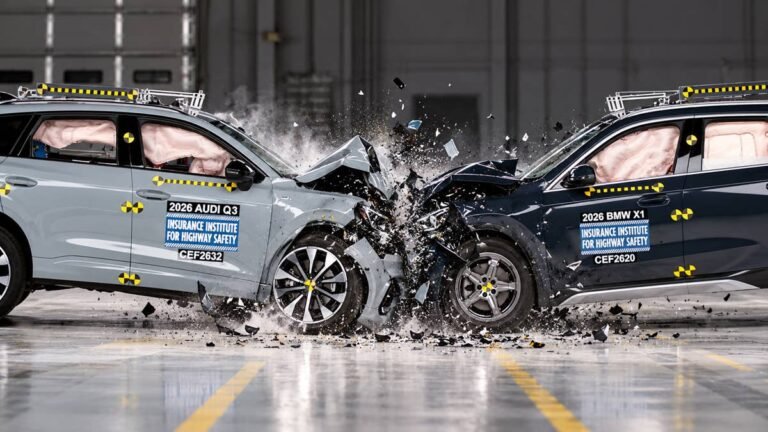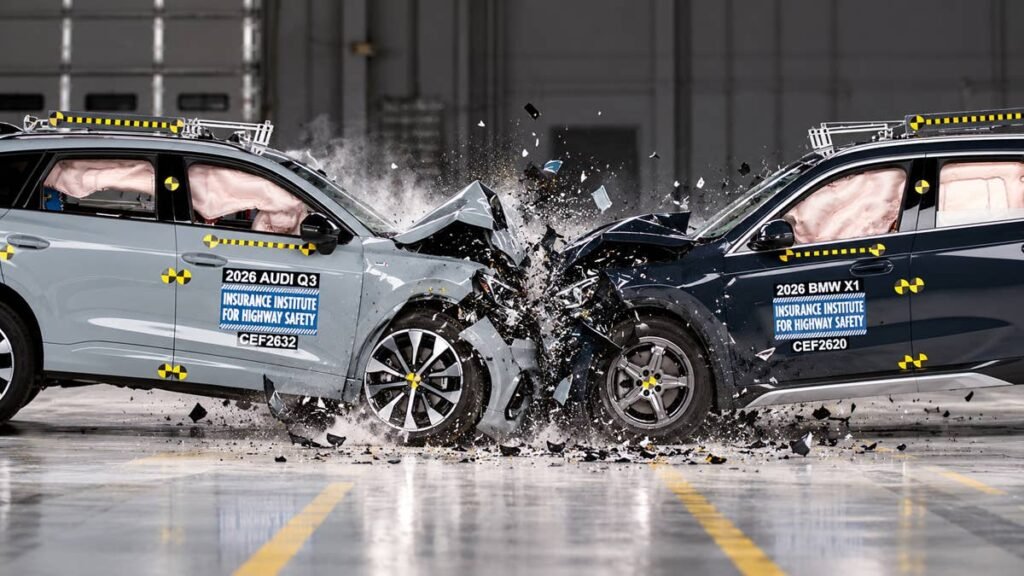
Audi introduced a new generation of the Q3 for the 2026 model year, with the subcompact crossover sporting a fresh design and a more powerful engine. For many luxury buyers and Audi fans, the Q3 represents the entry point into the brand’s lineup. It’s everything Audi fans appreciate, but in a more compact package. But does buying the smallest Audi SUV mean you have to make any safety compromises? To answer that, the new Q3’s safety results have been released by the Insurance Institute for Highway Safety (IIHS). We’ll compare them with one of the Audi’s key rivals, the BMW X1.
Crash Safety: BMW Outperforms Audi
The first portion of safety tests involves crash safety across three tests. These tests are the small overlap front, a 40-mph test involving 25% of the vehicle’s width; the moderate overlap front, involving a 40-mph test with 40% of the vehicle’s width; and the side-impact test. Every test receives a rating of Good, Acceptable, Marginal, or Poor.
|
Small Overlap Front |
Moderate Overlap Front |
Side |
|
|
Audi Q3 |
Good |
Poor |
Good |
|
BMW X1 |
Good |
Good |
Good |
Both vehicles performed brilliantly in the small overlap front and side tests, but the Q3 stumbled in the moderate overlap front test. For a fairly new design, the Audi’s Poor rating is disappointing. In this test, the Audi was marked down for a heightened risk of rear-passenger chest injuries. The rear passenger restraints and dummy kinetics were also marked down. Interestingly, the X1 also wasn’t perfect in chest-injury measures and rear passenger restraints, but its restraint system performed better than the Audi’s.
Due to the Audi’s moderate front overlap rating, it did not qualify for an IIHS safety award. The BMW had no such problems and earned the authority’s best Top Safety Pick+ award.
Related: Audi Is Now the Safest Luxury Car Brand, Beating BMW and Mercedes in New Safety Rankings
Crash Prevention: A Win For Audi
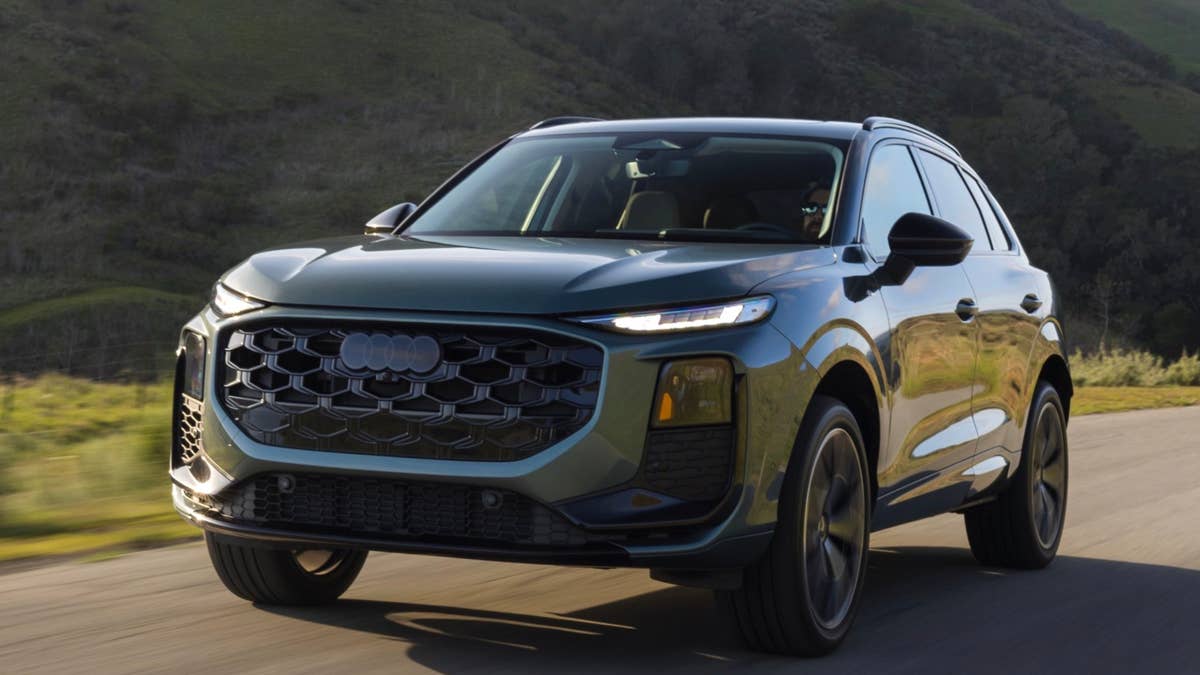
2026 Audi Q3
Audi
The IIHS also tests for a vehicle’s ability to avoid an accident in the first place, be it preventing a crash with a pedestrian or another car. The effectiveness of each model’s headlights is also tested.
|
Front Crash Prevention (vehicle-to-vehicle) |
Front Crash Prevention (pedestrian) |
Headlights |
|
|
Audi Q3 |
Good |
Good |
Good |
|
BMW X1 |
Acceptable |
Good |
Good |
The Q3 clawed back some points in this category, as its vehicle-to-vehicle crash-prevention system was judged to be better than the BMW’s. In this test, the X1 failed to avoid hitting a motorcycle target at 31 mph; it could only reduce its speed to 16 mph. The Q3 avoided the collision entirely in the same test. Both cars avoided a collision with a passenger car in all six tests.
Despite the BMW not being perfect for crash prevention, it still performed well enough to secure a safety award.
Final Thoughts
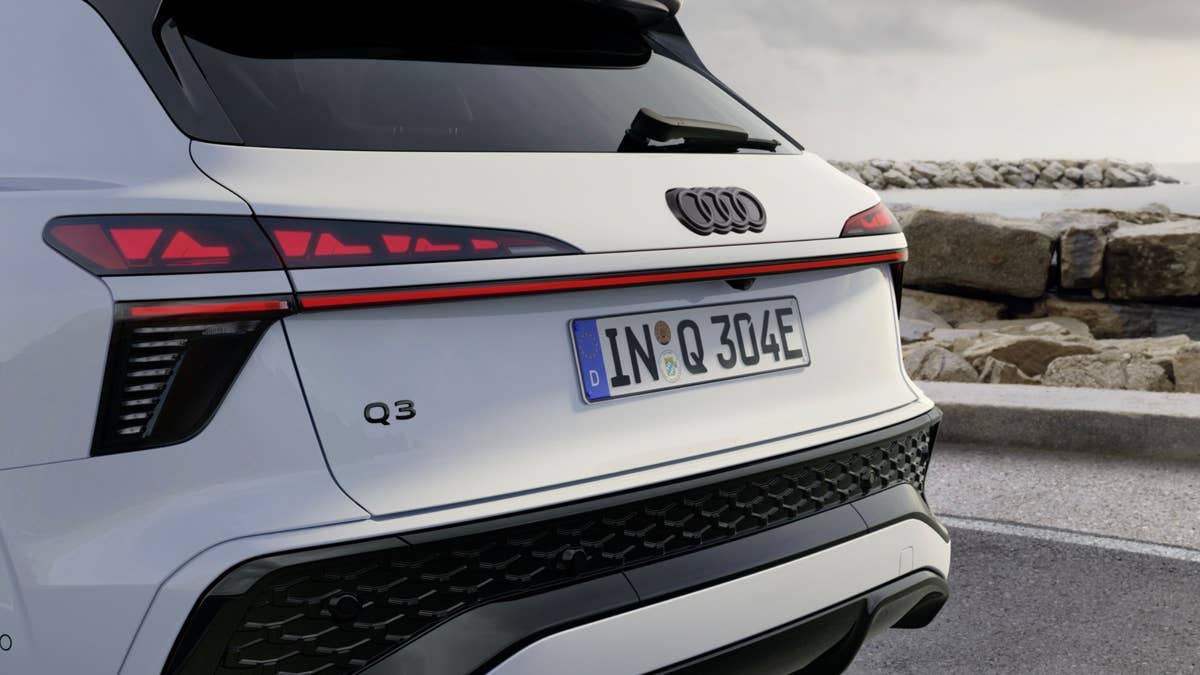
2026 Audi Q3
Audi
The Audi Q3’s performance in the moderate overlap front test is the only factor preventing it from securing a safety award. Since the IIHS updated this specific test in 2022 to include rear passenger safety, many models have struggled to achieve a top rating. Still, Audi would have expected to do so, given the fact that the Q3 is a new design. Many smaller, cheaper crossovers excelled in the same test, including the Mazda CX-30 and Nissan Kicks. For buyers who will often be transporting passengers in the back seat, the BMW X1 stands out as the more secure SUV for now.
Related: The IIHS Tested Seven New Cars, But Only Two Earned Safety Awards