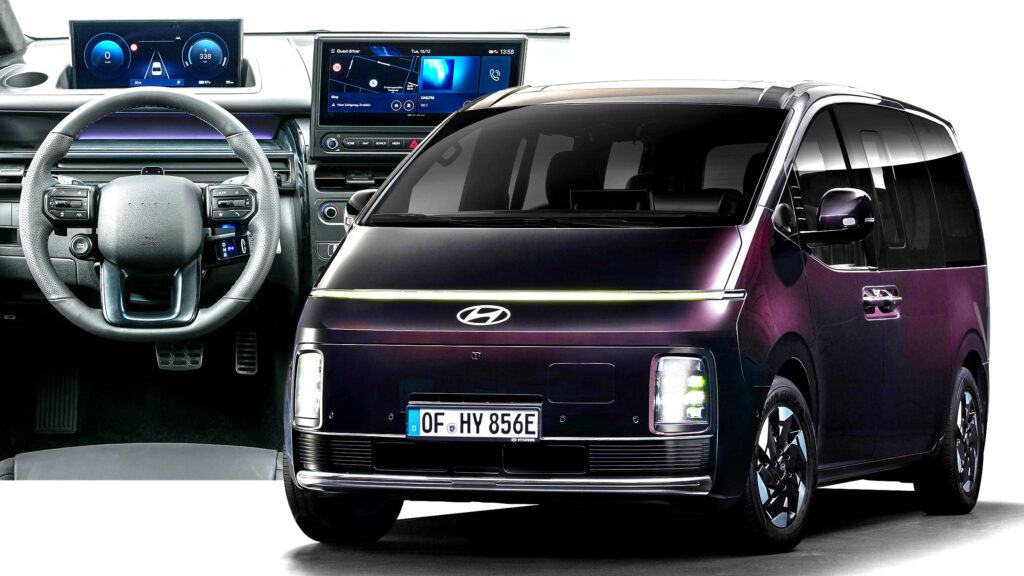
- Hyundai opens European orders for the new Staria Electric.
- It packs an 84 kWh battery and offers up to 430 km of range.
- The electric van is priced from €57,450 ($66,800) in Germany.
The Hyundai Staria Electric arrived in Korea earlier this year alongside the rest of the facelifted lineup, and the spaceship-shaped van has now made it to Europe, where Hyundai is positioning it against the VW ID. Buzz. The Staria is the bigger vehicle in every dimension that counts, with more room inside for people and their luggage.
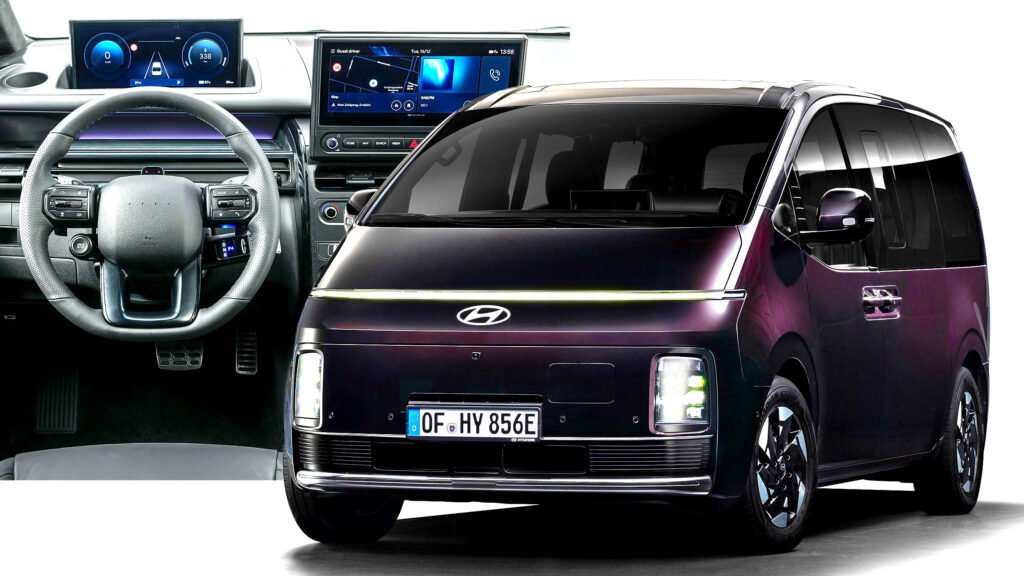
Picking the Staria Electric out from its gasoline and hybrid siblings takes a look at the nose, where a redesigned front bumper hides the grille behind a smooth panel, adds a charging port, and puts active shutters in the lower intake. Aero wheels and a dedicated badge on the enormous tailgate finish the job.
More: Electric Kia PV7 Is Coming For The Ford Transit
At 5,253 mm (206.8 in) long, the Staria towers over the VW ID. Buzz and the Kia PV5. It also out-measures the standard Ford E-Tourneo Custom, VW e-Caravelle, Peugeot e-Traveller, Citroen e-Spacetourer, Opel Zafira-e Life, and Fiat E-Ulysse, though the long-wheelbase versions of those go further. It’s the same story with the new Mercedes-Benz VLE executive shuttle.
Generous Equipment
In Europe, the Staria Electric is available in three trim levels, called Trend, Prime, and Calligraphy. The base version comes standard with full-LED headlights, dual 12.3-inch displays, heated front seats, parking sensors, a reversing camera, a few ADAS and a three-row nine-seater layout.
More: Hyundai Is Now Charging You Extra For A Damn Gauge Cluster
The optional assistance package adds navigation, highway assist and a V2L adapter, while the premium package adds electric sliding doors and tailgate, sliding windows, sunshades, acoustic and heat-insulating privacy glass, plus a wireless charging pad. All of those come standard in the Staria Electric Prime which adds leather upholstery and ventilated front seats while offering an optional sliding roof for the first row and fixed panoramic roof for the second row.
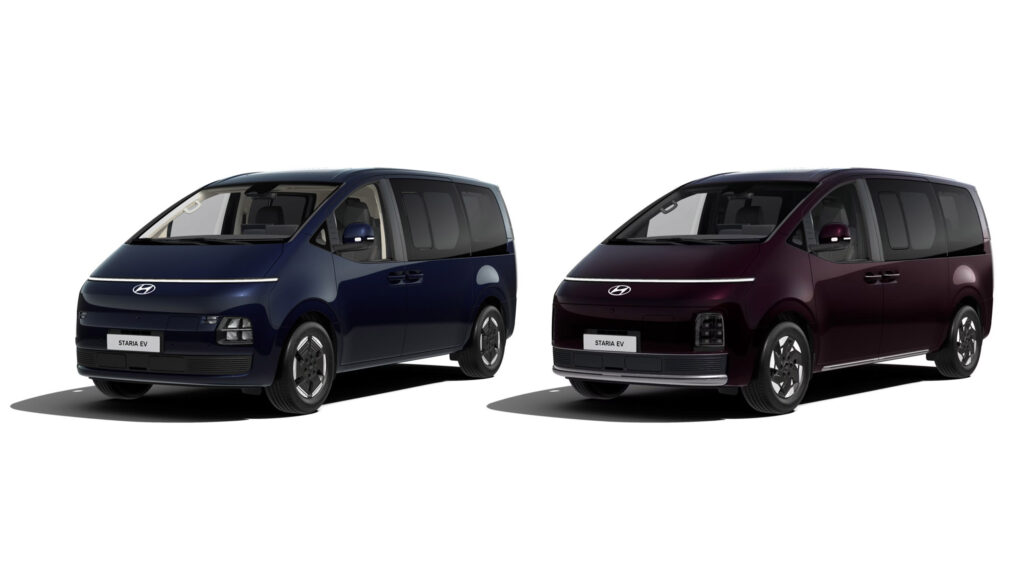
The pictured Staria Electric Calligraphy is the only version with a seven-seat layout, built around a pair of comfort seats in the second row with heating, ventilation, and relaxation functions. The flagship also gets ambient lighting, a Bose sound system, a 360-degree camera, a suede-style headliner, Nappa leather, and the Passenger View and Talk system.
More: You Can Sleep And Even Wash Your Dishes In This Hyundai Van, But You Can’t Buy It Yet
Outside, the Calligraphy separates itself with a different front bumper housing larger projection headlights, Parametric Pixel LED taillight towers that climb to the roofline, and an exclusive Galaxy Maroon paint option.
Space For Nine And Their Luggage
Cargo capacity runs to 1,303 liters (46.0 cu ft) behind the third row in the nine-seater, with a 24-liter (0.85 cu ft) frunk for the charging cables. Towing capacity is 2,000 kg (4,409 lbs) and maximum payload is 750 kg (1,653 lbs).
More: Kia Brought Its Electric Van To America As Something New York Actually Needs
Under the skin, the van is powered by a single front-mounted electric motor producing 215 hp (160 kW / 218 PS). Energy is stored in a 84 kWh battery pack allowing WLTP range of up to 430 km (267 miles) between charges. Thanks to the 800-volt architecture, the Staria Electric can charge from 10-80% in approximately 20 minutes when connected to a DC charger, while it also gets a standard heat pump and battery heating system.
German Pricing
In Germany, the the Hyundai Staria Electric starts at €57,450 ($66,800) for the entry-level Trend trim, €63,650 ($74,000) for the mid-tire Prime, and €66,950 ($77,800) for the flagship Calligraphy. The assistance and premium packages add €2,100 ($2,400) each, while the panorama package adds €1,300 ($1,500).
By comparison, the smaller VW ID. Buzz Pro with the long wheelbase and the 86 kWh battery starts at €57,887 ($67,300) in the same market. On the other hand, the VW e-Caravelle starts at €66,080 ($76,800) with the short-wheelbase and the 70.9 kWh battery.
Hyundai