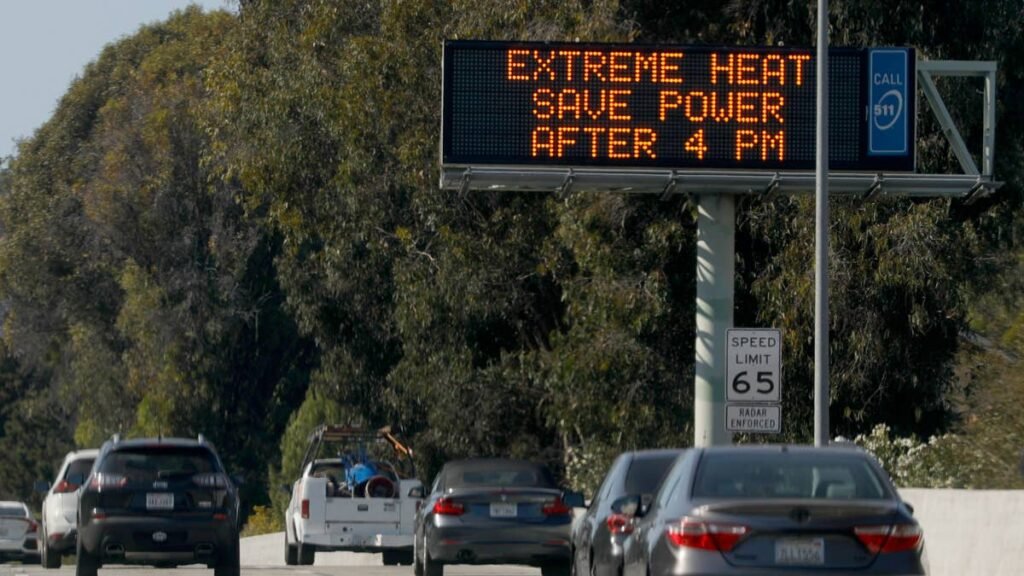
A second heat dome of the summer is locking down over the western and central United States this weekend, and the desert road corridors are taking the worst of it. The National Weather Service has posted Extreme Heat Warnings across the Desert Southwest, where afternoon temperatures are forecast to reach up to 117 degrees in the lowest desert basins. Forecasters describe a strong upper-level ridge parking over the region, sinking hot air toward the surface and trapping it there for days.
The most dangerous window runs Sunday through Wednesday, when desert segments of I-10 and I-15 could sit at 113 to 117 degrees and a stranded motorist without water or shade can slip into heat emergency within minutes.
What to Expect
- Widespread highs above 100 degrees across the Intermountain West and Plains, with isolated desert readings of 113 to 117 degrees, according to the Weather Prediction Center forecast.
- Major (Level 3) to locally Extreme (Level 4) HeatRisk from Friday through Wednesday, the two top tiers on the NWS scale.
- Overnight lows holding in the 80s across the low deserts, which means roads, vehicles, and drivers never fully cool off between afternoons.
- Temperatures running 15 to 25 degrees above normal, with the ridge expected to spread the heat eastward into the Plains early next week.
Road Conditions
Extreme heat is a road hazard in its own right, not just a comfort problem. Pavement in the low deserts can run 40 to 60 degrees hotter than the air, which accelerates tire failure on any tire that is underinflated, worn, or aging. Long climbs like the Cajon Pass on I-15 and the grades along I-10 through the desert push cooling systems to their limit, and overheating stalls tend to cluster on those pulls during the hottest part of the afternoon.
The bigger danger is what happens after a breakdown. On exposed desert stretches with long gaps between services, a disabled vehicle leaves occupants in triple-digit heat with no shade and limited cell coverage. Traffic backups behind a stall or a crash compound the risk, since idling in stop-and-go traffic in this kind of heat is exactly when marginal cooling systems give out.
Desert Southwest and the I-10 Corridor
California’s Coachella Valley, including Palm Springs, along with the San Diego County deserts, sit near the top of the forecast range at up to 117 degrees. The Tucson area is looking at 107 to 111 degrees, and lower elevations of the Grand Canyon are among the most dangerous spots in the country right now.
That puts the heaviest load on the I-10 corridor between the Coachella Valley and Arizona, the I-8 run across the San Diego County and Imperial deserts, and the I-15 pull between Southern California and Las Vegas through Baker and the Mojave. These are the segments where drivers should be most deliberate about timing, fuel, water, and vehicle prep before setting out.
Extreme Heat Driving Tips
- Check tire pressure before any desert drive, since heat raises pressure and a low or worn tire is far more likely to blow out on scorching pavement.
- Top off coolant and watch the temperature gauge on long grades. If it climbs, turn off the AC, run the heater to pull heat off the engine, and pull over safely before it redlines.
- Carry more water than you think you need for every person and pet in the vehicle, plus extra in case of a breakdown.
- Fuel up early and keep the tank above half. Stations are sparse on desert corridors and you do not want to idle for AC on fumes.
- Never leave children, older adults, or pets in a parked car. Interior temperatures can turn deadly in minutes at these levels.
- Drive the desert stretches early in the morning when possible and avoid the mid-afternoon peak between roughly noon and 6 p.m.
Timing
The heat builds through the weekend and peaks across the West from Sunday into midweek, then shifts and expands eastward across the Plains through July 15 under the same dome of high pressure. The heat dome is expected to cover as much as two-thirds of the continental United States before any meaningful relief arrives, so drivers across the Southwest, Great Basin, and Plains should plan around the heat for at least the next several days.