The argument over which E36 M3 is the one to own has been going on for thirty years. Americans who got the Lightweight will tell you their stripped-out, Alpine White track special is the definitive answer. Europeans who know about the M3 GT tend not to argue back. They don’t need to.
The E36 M3 GT is the right answer. It is not the most spartan, not the fastest in a straight line, and it is absolutely not the easiest to find. But it is the one BMW Motorsport actually sat down and built with purpose — a homologation special that came loaded with factory motorsport hardware and still managed to be a proper road car. That combination is what makes it special, and it is why values have climbed from around €50,000 for a clean example a few years ago to an average auction result now nudging six figures.
Why The GT Exists At All
The E36 M3 was not designed for racing. BMW M built it to chase a broader market than the hardcore E30, which meant more comfort, more refinement, and a chassis that was excellent on road but not obsessed with lap times. Then the World Sportscar Championship collapsed in 1993, and with it went the expensive Group C machinery. In its place, national GT series popped up across Europe and the US, with slashed homologation requirements that gave manufacturers a practical route onto the track without spending a fortune.
BMW went into the German ADAC GT series in 1993 with the E36 M3 GTR, a racing car with wide arches and an aggressive aero kit, and promptly won six of eight races. When they decided to attack the IMSA GTS-2 class in the United States for 1995, they needed to homologate some of the GTR’s aero and mechanical improvements for road use. The result was the M3 GT.
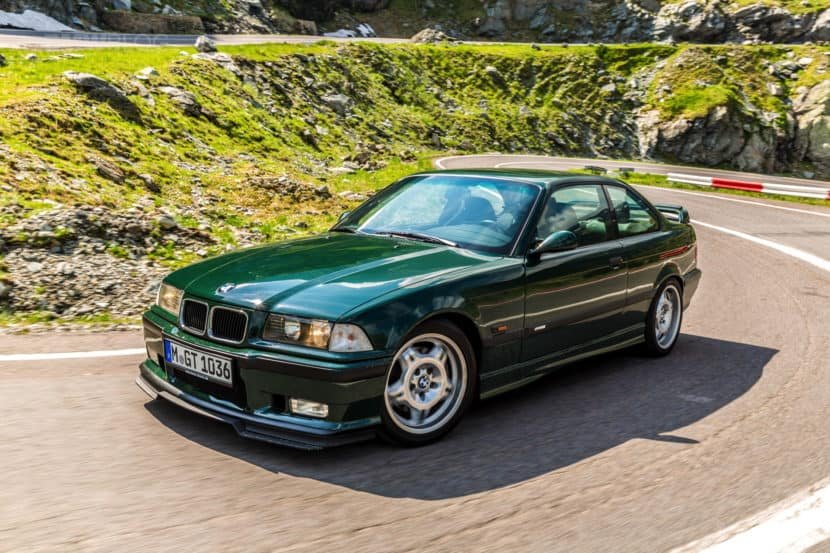
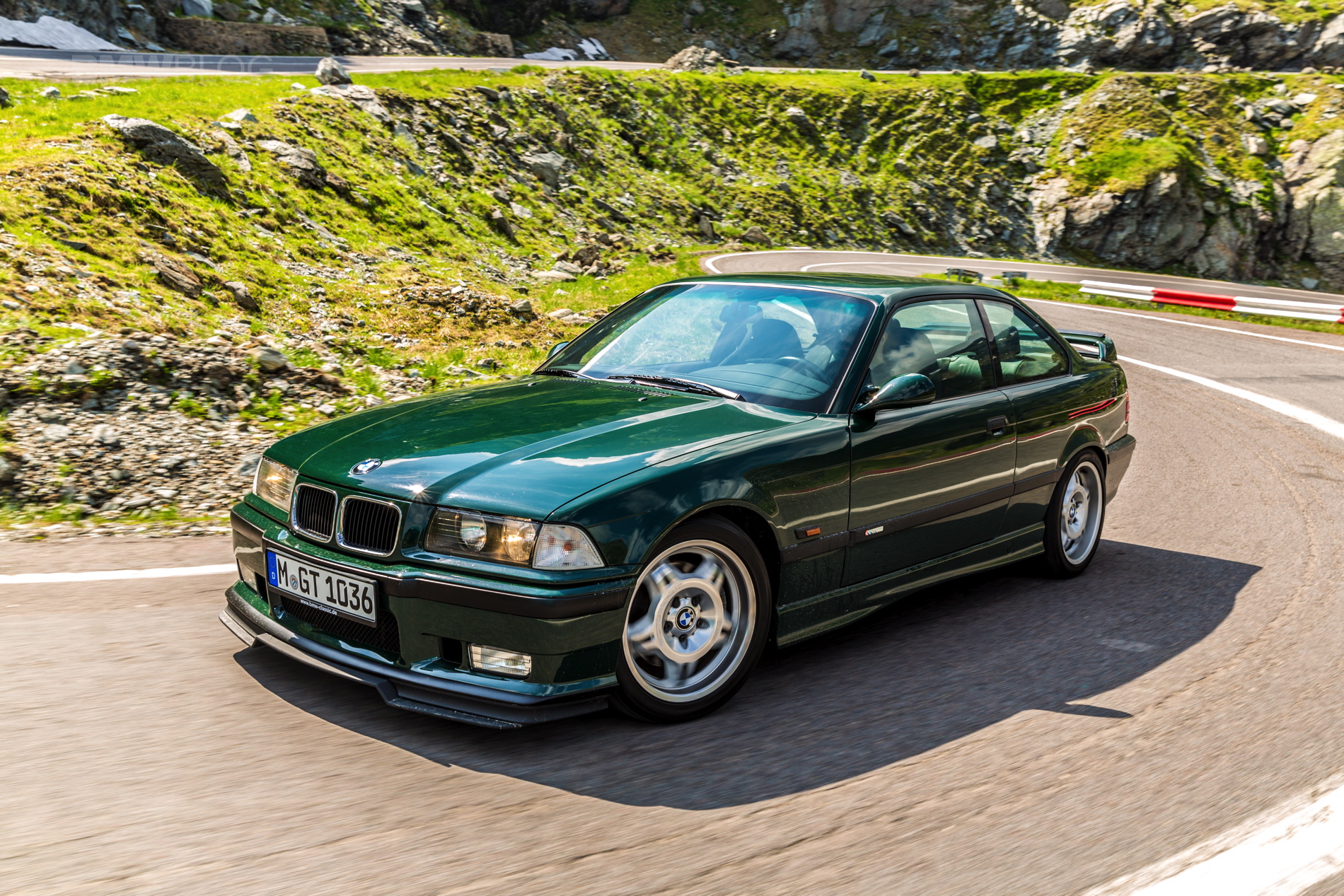
BMW Motorsport planned a run of 350 road cars, all left-hand drive, all sold exclusively in mainland Europe, and all painted in a single color: British Racing Green. In the end, 356 were built.
Why Are They Special

Start under the bonnet. The GT uses the same 3.0-liter S50 B30 inline-six as the standard E36 M3 — 24-valve DOHC, single VANOS on the inlet cam, individual throttle bodies for each cylinder. But BMW Motorsport reground the camshafts to a 264-degree profile, remapped the Bosch Motronic M3.3 engine management, upgraded the VANOS software, and fitted the same short intake manifold that would later appear on the 3.2-litre M3 Evo. The oil pan got a baffled design with dual pick-ups to maintain oil pressure in hard cornering — a detail that matters on track and tells you exactly what this car was conceived to do.
Peak power went from 286 bhp to 295 bhp at 7,000 rpm. The torque figure moved to 238 lb-ft at 3,900 rpm, and BMW Motorsport shortened the final drive ratio to improve in-gear response. These are not dramatic numbers on paper, but the recalibrated engine feels meaningfully different in the mid-range — sharper, more immediate, and happy to rev harder before it runs out of breath.
The chassis changes matter just as much. A Motorsport front strut brace reduces bodyshell flex. Shorter and stiffer springs drop the ride height noticeably. The ABS was retuned specifically for the GT. And to save 20 kilograms, the doors are aluminium — identical in appearance to steel, but lighter in a way you notice when you swing one open.
The Only Color It Came In

British Racing Green. That is it. One exterior color, no options, no exceptions — with one documented pre-production exception that effectively proves the rule. Every production M3 GT left the factory in the same deep green, paired with an interior that matched the paint’s intent rather than contradicted it. The Vader sport seats are trimmed in Anthracite Amaretta brushed suede with Mexico Green Nappa leather on the seat centres, door inserts, and grab handles. The dashboard, door sills, and centre console get carbon fibre inserts. There is a serialised production plaque mounted above the glovebox.
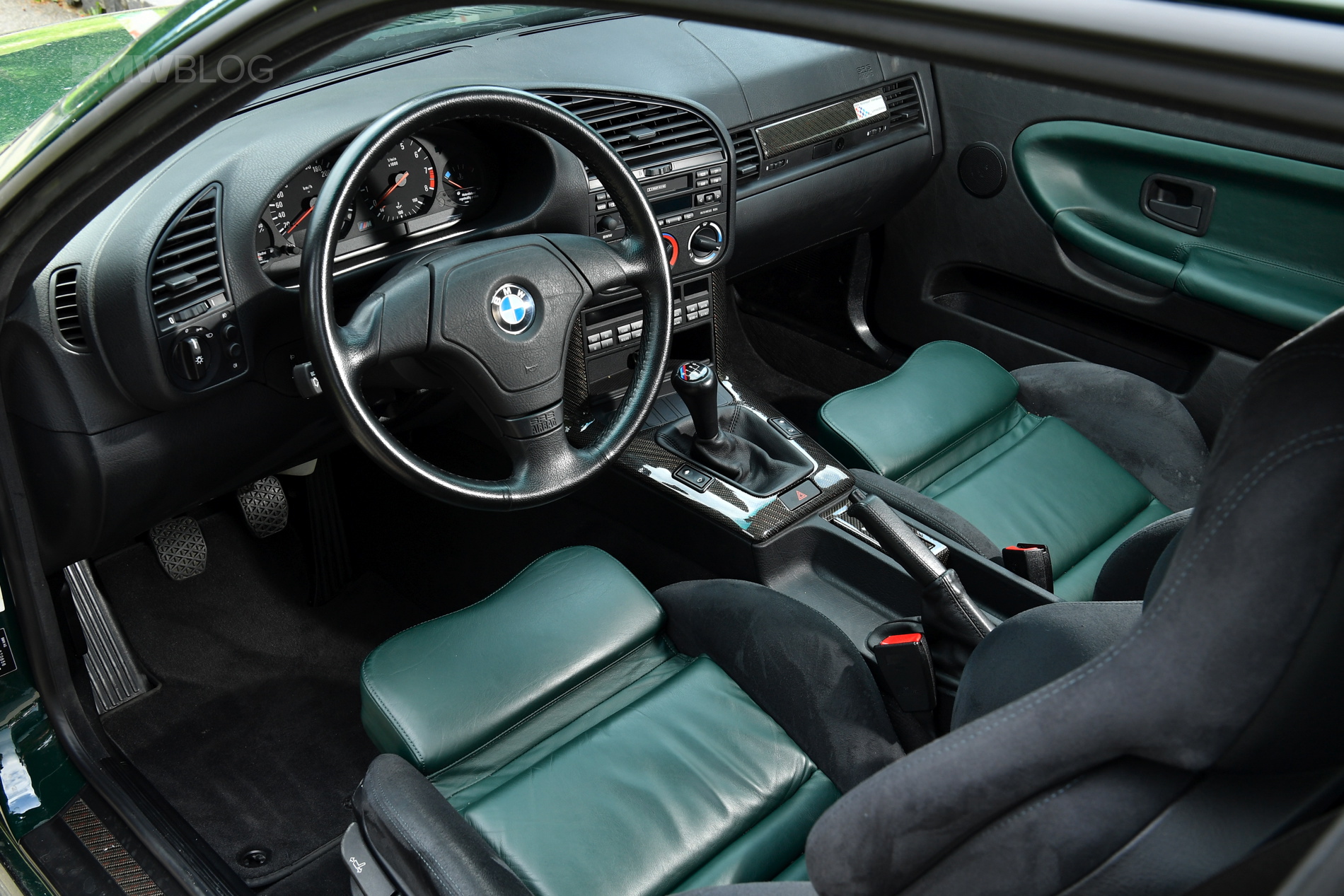
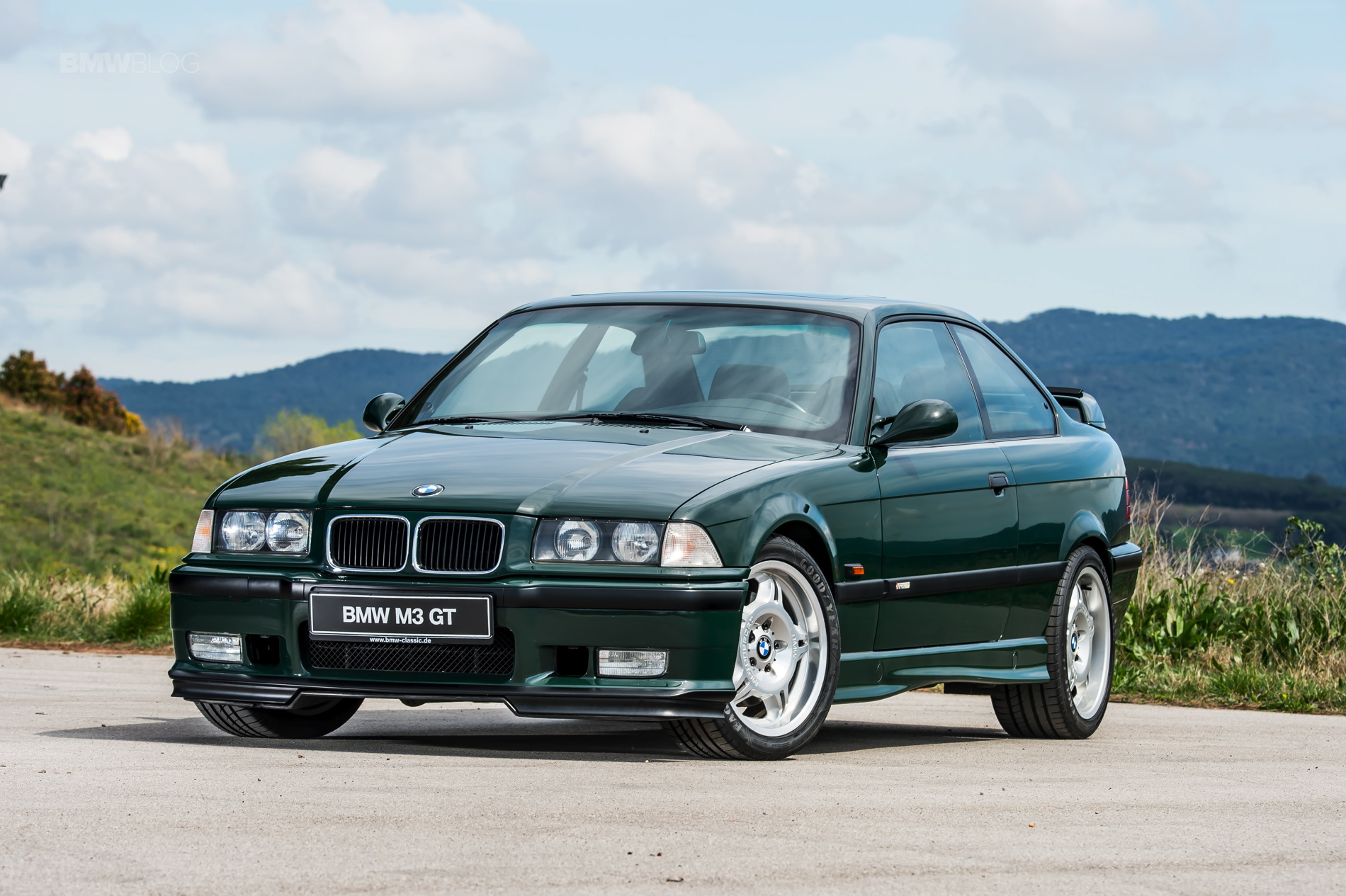
The GT never wore external badging identifying it as such. The only external tells beyond the paint are the biplane rear spoiler, the adjustable front chin splitter, aerodynamically optimized mirrors, and the clear front indicators that replaced the standard car’s amber units. BMW Motorsport International emblems sit on the door moldings and kick plates. The wheels are polished 17-inch M Double Spoke forged alloys — 7.5 inches wide at the front, 8.5 at the rear.
A Complete Car, Not A Stripped One
This is where the GT parts ways with the Lightweight philosophy. BMW did not pull the radio out. They did not delete the air conditioning. Buyers could tick almost the full options list available on the regular M3 — heated seats, cruise control, onboard computer, headlight wash/wipe. It is a car that went to the track on weekends and drove home on Monday. That usability is part of what makes it the better long-term ownership proposition.
For American Readers: The Lightweight

The M3 GT was never sold in the United States. It was left-hand drive only and stayed in Europe. American buyers who wanted a factory-special E36 M3 in 1995 got the M3 Lightweight instead — which is not a consolation prize, even if it was designed with a different logic.
The Lightweight strips the US-market M3 down rather than building it up. Air conditioning is deleted. The radio is gone. Sound deadening is gutted. The seats are lightweight cloth units rather than leather. Aluminum doors carry over from the GT’s parts bin. The springs and dampers are the same spec as the GT’s, and a factory Motorsport strut tower brace and underfloor X-brace come standard. All of that brings the kerb weight to 2,950 pounds — 225 pounds less than a standard US M3.
The engine is the US-market S50 B30, not the Euro version. That means 240 hp at 6,000 rpm rather than 295 hp at 7,000 rpm. The US cylinder head was a cost-saving measure when BMW adapted the M3 for American emissions standards, and it is the one area where the Lightweight cannot match the GT regardless of how much you strip it out. The five-speed gearbox (rather than the Euro six-speed) is a further reminder that this was always the global platform adapted for one market rather than a car built from scratch.
With only 126 produced, all in Alpine White with the Motorsport chequered flag decal, the Lightweight is rarer than the GT. And rarity has pushed prices accordingly — exceptional low-mileage examples have sold for over $195,000 at auction.
What You Pay For A GT Today
The market data is clear that the GT’s time as a relative bargain has passed. A well-maintained example with a clean history was selling for around €50,000 a few years ago. By late 2024, documented examples were trading in the €76,000 to €90,000 range in Europe, and a high-water mark of $275,000 was set at auction in October 2025 for an exceptional car. The average across recorded sales sits around $132,000. That range is wide enough that condition and history drive the number more than anything else.
The GT commands four times that at the low end than the regular E36 M3. That premium is not irrational.
First published by https://www.bmwblog.com